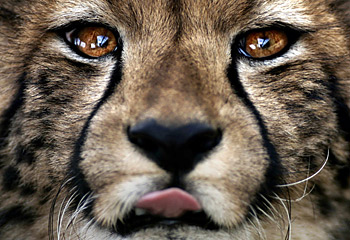
Jama The King Cheetah- Why We Remember Him
|
J |
ama the king cheetah was an icon for the Canberra Zoo, wowing visitors with his strikingly beautiful appearance and calm nature. People could pay just $200 to go into his enclosure and play with him, and his sister November (a normal spotted cheetah). You could do a simple Google search of his name and there would be hundreds of pages dedicated to this amazing big cat.
People from all over the continent have come to visit Jama,
scratching under his chin while he chewed on his food, hugging him and rubbing
his tummy while he lay next to you.
Being a king cheetah, he was different than normal spotted
cheetahs. Being one of only thirty kings in the world, he had three long
stripes running down his back and black splotches covering his entire
body. King cheetahs are larger than
normal cheetahs, and have a fluffy, small mane around the necks.
Reaching speeds of up to 110km/h, the cheetah is a fast kitty. Cheetahs are the fastest land animal on earth, accelerating faster than most sports cars. They can go from zero to sixty kilometers an hour in two point five seconds. Pretty amazing!
The king cheetah was first noted in Zimbabwe in
1926. There were reports of a few sightings here and there, but no one knew
much about this illusive creature. Its species status was resolved in 1981 when
king cheetahs were born at the De Wildt Cheetah Center in South Africa from
normal parents.
In May 1981, two spotted
sisters gave birth there and each litter contained one king cheetah. The
sisters had both mated with a wild-caught male from the Transvaal area (where
King Cheetahs had been recorded).
Only 10 king cheetahs are believed to be in the wild in a few remote areas of Zimbabwe and Southern Africa and an average of twenty in zoos. The De Wildt Cheetah Centre in Pretoria, South Africa is largely responsible for their preservation and present day population.
Jama, coming from De Wildt
to the Canberra National Zoo and Aquarium was lucky to survive as a tiny cub.
After being rejected by his mother when he was born, Jama was hand reared by
humans. Being born in captivity, meaning he can’t go back into the wild, Jama
was sent off to the Canberra National Zoo with his half sister, November. The zoo soon opened a ‘Meet the King’ program
where people over the age of twelve could go into the enclosure and pat and
play with the two amazing cheetahs. The Canberra Zoo is also home to three
other spotted cheetahs, Tanzi, Robi and Shasa.
But at the age of three,
Jama started developing kidney problems. On August the 22nd 2008,
Jama passed away. The problem was caused by too much protein in the cats diets.
This is a common problem, even in tiny house cats. November now lives by
herself in her Canberra enclosure, which she once shared with one of the most
amazing creatures on the planet.
Jama will be remembered as
the amazing cat that touched many hearts. The zoo still offers a ‘Meet a
Cheetah’ program, featuring Tanzi, Robi and Shasa. But the zoo just won’t be
the same without its icon. May Jama rest in peace.
By Stephanie McGrath

